AAUP Ohio Conference

American Association of University Professors

  • About
    • Who We Are
    • Board of Trustees
    • Staff
    • Committees
    • Events
      • Annual Meeting
      • Board Meetings
  • Membership
    • Chapters & Presidents
    • Join AAUP
  • Government Relations
    • Current Legislation
    • Find Your Legislators
    • SB 1 Toolkit
  • News & Blog
  • Donate

May 20 2020

Why billionaires want you to opt out of your union

[This message is borrowed from our friends at the Ohio Federation of Teachers (OFT). Educators in Ohio are starting to be contacted by “The Freedom Foundation” to encourage them to “opt-out” of their union membership in an attempt to further weaken unions after the Janus U.S. Supreme Court ruling.]

Who is the Freedom Foundation?

The Freedom Foundation is the latest in a long line of well-funded union-busting front groups that have set up shop in Ohio in an attempt to weaken our union and push their privatization agenda. The goal of these messages is to persuade union members to opt out of their unions, which would weaken our union voice and jeopardize the standards (pay, benefits, working conditions, rights at work) we have won over many years.

Weakening standards in public education, higher education, and children’s services is not just an attack on us, it’s an attack on Ohio’s students and children. It’s no surprise that Freedom Foundation receives funding from Donors Trust (funded by Charles Koch) and the Richard and Helen DeVos Foundation (funded by the family of U.S. Secretary of Education Betsy DeVos). The one percent increases their wealth and power by weakening the power of the 99 percent.

How did they get my email address or phone number?

Neither OFT nor your local union has provided any personal information to these groups or to any groups outside of our union. Safeguarding your personal information is a top priority for us.

Opt Out Today / Freedom Foundation has obtained some information through Freedom of Information Requests to state agencies, public employee retirement funds, and school districts. Since that information would not contain mobile phone numbers, we expect they have also purchased phone numbers from a vendor to match up with the names they had received through information requests.

What should I do if I’m contacted by Opt Out Today / Freedom Foundation?

If you are interested in having less power at the negotiating table the next time your contract is up, or you are interested in having fewer rights at work, then opting out of your union might be for you. You are welcome to reply to Opt Out Today / Freedom Foundation. However, you do not need to contact Opt Out Today / Freedom Foundation to opt out of your union. In your union contract, you can read how and when members of your local can withdraw membership.

If you do not want Opt Out Today / Freedom Foundation contacting you and seeking to weaken your union, here are some steps you can take.

  • Let your Building Rep. or Local leadership know that you were contacted.
  • Talk to your co-workers about this. Even though we are physically distanced from each other, it’s more important than ever that we check in with our co-workers, see how they’re doing during this stressful time, and make sure they understand that an anti-union front group may be contacting them.
  • If you were contacted by email:
    • Any email they send should have an “unsubscribe” link at the bottom. Click to unsubscribe. If there is no unsubscribe link, or you are emailed again after you unsubscribe, let us know.
    • Since they emailed you through a mass email list that you did not sign up for, you can also report their email as spam by signing up for a free, anonymous account on spamcop.net
  • If you were contacted by text:
    • They are using very ambiguous language that says “Reply stop to opt out.” It is unclear whether this is to opt out of text messages from them or to show interest in opting out of your union. We expect the language is intentionally vague in an effort to inflate their number of replies.
    • We suggest you respond with: “Please remove me from all text, phone, email, and mailing lists.” If they continue to contact you after that, let us know.
    • You can also block the phone number they are sending texts from, however they can change that number at any time and text from a different number

The Freedom Foundation, funded by out-of-state billionaires, knows how powerful a union voice can be and that’s why they’re spending so much money to collect your personal data and contact you. Let’s show them that we also understand what a strong union is worth.

Written by · Categorized: Blog

Apr 17 2020

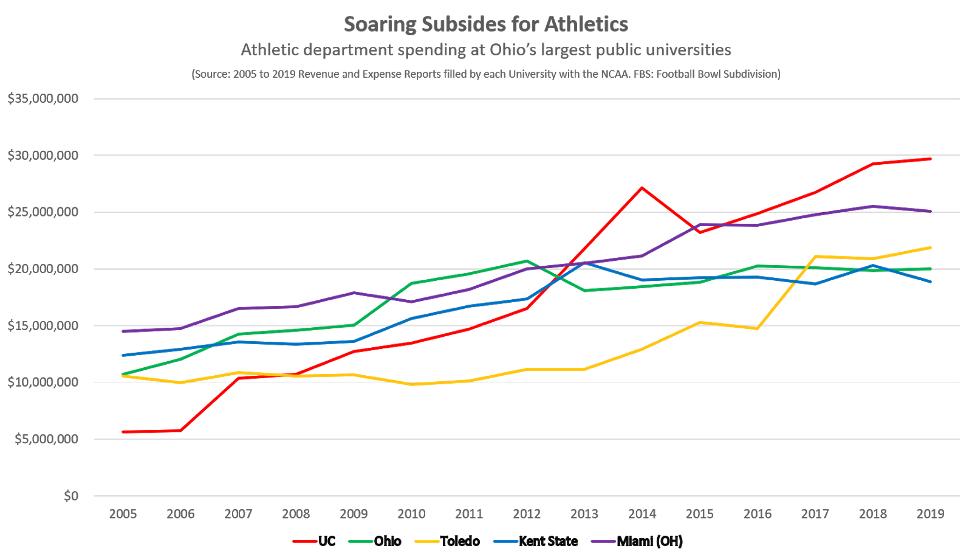
UC student paper calls out 12-year ‘quarter of a billion dollar’ athletic deficit

The News Record, an independent University of Cincinnati student newspaper, published an article on April 14 calling attention to the cumulative deficit accrued by UC’s athletics department over the last 12 years.

Highlighting the ever-increasing athletic spending, the article states, “These annual deficits, paid for with tuition and other general fund dollars, have taken an enormous financial toll on the university’s bottom line. Over the past 12 years, deficits in the athletic department have totaled more than $250 million, according to UC’s NCAA Revenue & Expense reports from 2008 through 2019.”

Deficit Chart

The piece goes on to quote Ohio Conference AAUP president John McNay: “It is totally irresponsible but, through several administrations, the university appears totally committed to squandering greater and greater financial resources on playing games.”

We encourage you to read the full article here.

Written by · Categorized: Blog

Mar 20 2020

New faculty: What you should know about STRS retirement plans and benefits

You are a new faculty member at an Ohio public college or university — congratulations! Obviously, the first thing you have done is joined your local AAUP chapter or union. There is no better way to protect academic freedom, the security of the profession, and your own interests as a faculty member than joining the AAUP.

But among the many pieces of paperwork being put in front of you is one asking you to select your retirement plan with the State Teachers Retirement System (STRS).

STRS Ohio has excellent information on their website about the options available to higher ed faculty for their retirement plan. You can choose from the traditional defined benefit plan, a “401(k)-style” defined contribution plan, or the combined plan. We strongly encourage new faculty members to carefully review the information on the STRS site to decide what plan is best for you.

However, there are some pieces of information that STRS does not mention that we think faculty should know while considering their decision.

Drawbacks of the Defined Benefit Plan

Unless substantive factors impacting the funding of the retirement system change, as a member of the defined benefit plan, you likely will pay more into the system than you will get out of it in retirement. This is because STRS uses all of the employer contribution, plus some of your contribution, to pay down the system’s unfunded liability.

Another thing to note about the defined benefit system is that its members traditionally have received an annual cost of living adjustment (COLA), but the COLA was suspended indefinitely in 2017 to help shore up the funding of the system.

Members of the defined benefit plan continue to have access to healthcare coverage (medical, dental and vision) provided that a member has 15 years of service credit. Beginning August 1, 2023, new retirees will need 20 years of service for eligibility. However, healthcare coverage is not guaranteed and STRS can change program eligibility at any time.

Drawbacks of the Defined Contribution Plan

For those in the defined contribution plan (also called the “Alternative Retirement Plan” or ARP), STRS takes a percentage of your employer contribution and uses it to help pay down the unfunded liability in the defined benefit plan. The percentage is called the “mitigating rate,” as its intended to mitigate the negative impacts to the defined benefit system that occur when someone chooses the defined contribution plan. The current mitigating rate is 4.47%.

ARP members are not eligible for STRS healthcare benefits.

Implications for Social Security Benefits

It also is important to understand that, as an Ohio public employee enrolled into a state retirement system, you are not paying into Social Security and this dramatically reduces your Social Security benefits.

Before 1983, people whose primary job wasn’t covered by Social Security had their Social Security benefits calculated as if they were long-term, low-wage workers. They had the advantage of receiving a Social Security benefit representing a higher percentage of their earnings, plus a pension from a job for which they didn’t pay Social Security taxes. Congress passed the Windfall Elimination Provision to remove that advantage.

Then there is the Government Pension Offset rule that affects workers with government pensions who also receive Social Security spousal or survivor benefits. It reduces the amount of those benefits by two thirds. The rule does not affect your own Social Security benefits (if any) nor your government pension, nor does it reduce the benefits belonging to the spouse. It is important to understand that if your spouse dies before you, you will not get their higher Social Security payment.

You should consult a Social Security advisor to determine exactly how these factors impact your individual circumstance.

We Fight for Good Pensions

The Ohio Conference AAUP advocates for quality pensions for college and university faculty. Market downturns and political pressures have caused benefit reductions and age/service/contribution requirement increases in recent years, but we have helped mitigate decisions that could have had more severe consequences for active educators and retirees. We will continue to fight for good pensions for our members.

Want to understand more about pensions? Visit this Pension Education Toolkit.

Written by · Categorized: Blog

Mar 19 2020

Your Must-Read: Academe’s Coronavirus Shock Doctrine

Photo of Kornbluh, Anna
Anna Kornbluh

The following article was published by The Chronicle on March 12, 2020. The author, Anna Kornbluh, is an associate professor of English and AAUP member at the University of Illinois at Chicago. She is also the daughter of University of Cincinnati-Blue Ash history professor emeritus Andrea Kornbluh, a long-time AAUP member.

Academe’s Coronavirus Shock Doctrine

Faculty members are already stretched thin, and now they are being asked to do more. They should hesitate before doing so.

Never let a crisis go to waste. In her bestselling book The Shock Doctrine: The Rise of Disaster Capitalism, Naomi Klein observes that disasters, emergencies, and breakdowns often prove inspirational to entrepreneurs, and just as often provide ideological cover for the repurposing of public funds and the reconfiguration of labor conditions. Covid-19 looks like it will furnish exactly this sort of pretext. Faculty members — a variegated group that has not excelled at thinking of ourselves as a collective — should beware.

As the home of expertise across the research and medical sciences, public policy, and human expression, universities are taking a leadership role in responding to this pandemic, especially given the absence of a functioning federal government. Being on the front lines means that universities are acting rapidly to take the kinds of dramatic steps necessary to flatten the contagion curve and limit harm. But unlike some elementary schools or businesses, U.S. universities are not simply closing; they are ordering faculty to ensure “continuity of instruction” by moving classes online. 

Faculty must have a seat at the table when redefinitions of teaching are taking place. 

Online education has several benefits and has seen experimentation and progress, often thanks to big budgets. Yet the mandate for this sudden conversion of large swaths of higher education to an online format threatens to trigger a breakneck paradigm shift with unforeseen ramifications. Shock doctrines make emergencies the new normal — they turn temporary exertions into permanent expectations. American higher education has already endured several slow-moving disasters over the past 40 years: the radical defunding of public institutions, the casualization of academic labor, the militarization of campus security, and the erosion of faculty governance. As a result, the very instructors now tasked with the herculean transition are already working in extreme conditions: Somewhere between two-thirds and three-quarters of college and university teaching is performed by non-tenure-track faculty members or by graduate students, many of whom conduct heavy course loads without health insurance and with suppressed wages, housing insecurity, and stifling debt.

The directive for immediate transition conceals a tremendous labor intensification. Faculty are being asked to redesign their courses and reinvent their pedagogy on an emergency basis. Are there appropriately urgent ways to limit virus exposure while also allotting time for these laborious undertakings? Could all courses be suspended for a week to give faculty time to survey students about their internet access, computer ownership, and data limits — and to give institutions time to redress inequities in student access? What about time for faculty to reconcile the lack of alternatives to face-to-face learning for laboratories, ensembles, seminars, and studios? Time for disability services offices to train faculty members in online accommodations? Time for institutions to devise support systems for faculty teaching from “home” when home might be scrambled by young children whose own schools are closed? Time to develop collaboration workarounds with crucial staff, who should also be afforded “social distancing”?

While we need institutional support for these transitions, we also need to be involved in decision making. We are the experts in the classroom, so we should have a seat at the table whenever redefinitions of “classroom” and “instruction” are taking place. We must have autonomy over the new paths for our courses. We are the ones who meet students face to face, so we know not to underestimate the uncertainties confronting those whose families may be sick or vulnerable, whose employment prospects may be uncertain, whose campus lives are disintegrating. The edict that students continue the labor of education amid calamity is its own strain-normalizing spike. Students want to learn, and faculty members want to teach, desperately so in devastating times, but crisis learning must not exacerbate the existing crises in higher education.

What comes after the shock? If instruction is going to be utterly transformed, then other protocols and systems must be too, and faculty members ought to insist upon assurances and protections now. Intellectual property rules by which universities claim ownership over materials uploaded to course-management software must be completely suspended; we cannot willingly contribute to the rebranding of education as “content delivery.” Universities must explicitly ensure that third-party platforms will not monetize our words for Big Data and our faces for surveillance industries. Faculty performance reviews (crucial to renewal for contingent faculty, to merit pay, to tenure proceedings) should be reformatted to account for the derailed “outputs” when conferences and guest lectures have been canceled, publications slowed, and alternate teaching strenuously improvised. Student evaluations should not be proctored or employed as usual. Face-to-face learning is irreplaceable — even in a virtualizing culture, even when classroom infrastructures are overcrowded and outmoded, even when administration has become the dominant sector in education. Absent firm administrative commitments to resume ordinary instruction after the virus subsides, and in the presence of administrative memos specifying “indefinite” and “permanent” dimensions of the transition, faculty as a group should pause before making the extraordinary efforts now demanded.

Societal straits present openings for reinvention. The history of capitalist crisis shows how often these reinventions have come at the expense of average workers. But faculty are a creative lot who should be able to anticipate and deflect the risks of coronavirus shock doctrine. We must seize this moment to organize for student-debt relief, student and faculty health care, and the public goods of research and expertise. Tasked with conjuring continuity in a pandemic, we find ourselves at a precipice that clarifies how much we have overworked to weather the structural adjustment of higher ed, and how much we have in common with each other — with the hourly employees who make the university and its surrounding businesses go, with our students, with the school teachers who’ve been struggling and striking nationwide. A cataclysm is here. What can we collectively rebuild?

Written by · Categorized: Blog

Mar 10 2020

Should John Kasich Be the Next President of The Ohio State University? (Part 3)

PART THREE OF A THREE-PART SERIES

Part One of this three-part series explored the reasons why having any former governor serve as the president of a public college or university in that state, and especially as president of that state’s flagship public university, is a bad idea.

Image result for charter university john kasich
John Kasich

Part Two addressed the reasons why having a former governor with an ideological bent toward privatization and corporatization in such a role is counter-intuitive and demonstrably problematic.

In Part Three of this series, we now address why former Governor John Kasich is a particularly problematic choice to lead Ohio’s flagship public university.

As governor, Kasich was no friend to public higher education. Let’s review.

Governor Kasich’s 1st Budget – 2011

In his first biennial budget in 2011, Kasich slashed the main funding source to colleges and universities (State Share of Instruction or SSI) by 12%.

In that same budget, the governor attempted to undermine the whole concept of public universities by proposing a “charter university” system. The idea was that, in exchange for less state funding, universities would be “freed” from many state regulations (such as tuition caps, construction requirements, public records laws).

Fortunately, the legislature cut this proposal from the final budget. However, the compromise was to allow universities to lease “auxiliary services,” such as parking and residence halls, to private companies.

Image result for ohio state parking system lease
OSU’s student newspaper, The Lantern, made a point to show how much can change in a 50-year period when the university entered into the long-term parking system privatization deal.

Ohio State has taken advantage of this by leasing its parking system in 2013 for a 50-year period in exchange for a one-time $483 million payment. Similarly, the university leased its energy facilities in 2017 for 50 years for an upfront payment of $1 billion.

While these seemingly lucrative deals are undoubtedly tempting for universities which have been left behind by the state, essentially selling off public assets for one-time payments is short-sighted and an unsustainable budgeting model.

Moreover, Kasich was openly hostile toward faculty in his inaugural budget. During his initial gubernatorial campaign, he said he would make professors work harder. This was ironic, given that Kasich had just come off of a very lucrative deal to appear in an OSU classroom for $4,000 an appearance. He was paid $50,000 a year for no more than four visits to the classroom per term. After milking the system for so much money for doing so little, it is hard to understand how he could possibly criticize full-time faculty.

Nevertheless, Kasich’s executive budget included a provision that faculty would have to teach one additional course every other year (with no end date or other specificity). Perhaps he thought that every professor earned $50,000 for giving four lectures a term.

Yes, while sending a message with charter universities that universities were too burdened with regulation, Kasich wanted to micromanage faculty workload. The legislature ultimately abandoned this idea, too.

Governor Kasich’s 2nd Budget – 2013

In his second biennial budget, Kasich couldn’t help himself but to introduce yet another workload mandate for faculty. This time, he was sure to include greater specificity. All research and instructional faculty would have had to teach one additional course from the previous academic year. The language, however, was permissive — boards of trustees could choose to adopt this or not. Nevertheless, legislators decided to eliminate it from the final bill.

In addition, it was this budget that Kasich introduced a new funding model for higher education, one that moves away from enrollment to one based primarily on course completions and graduations. We warned the legislature of the perils of moving from an opportunity-based system (enrollment) to a production-based system (course completions and graduations). Legislators did not heed our warnings, and our predictions have come to fruition.

Image result for college credit plus
College Credit Plus ad from the Ohio Department of Higher Education.

As a result of the new funding model, institutions that have selective admissions, and thus more students that perform well, are being even more rewarded with SSI dollars. Conversely, this has hurt open-access institutions, and has incentivized them to become more selective with admissions.

Moreover, Kasich pushed for a vast expansion of Post-Secondary Enrollment Options (PSEO) by introducing “College Credit Plus” (CCP). It used to be the case under PSEO that high-achieving high school students could earn college credit by attending classes at their local college or university. But under CCP, even 7th graders can take “college” courses, most of which are taught in the high school. Rather than properly fund higher education, Kasich’s idea with CCP was that students and the state can save money by pushing students through their education as quickly as possible.

But, as usual, he ignored the unintended consequences. The lower division classes that are now the core of CCP have been the bread and butter of colleges and universities, which have suffered financial harm by CCP usurping these courses.

Of course, the irony was probably lost on Kasich and Republican legislators that they want public high schools to teach college courses, even though they contend the same schools are inadequate as a justification for “school choice”/support for charter schools.

Governor Kasich’s 3rd Budget – 2015

A big piece of the governor’s third budget was pushing “competency-based education” (CBE). The idea behind CBE is that one can take a test to prove that they know material rather than having to take courses they might not otherwise need. CBE has been used for many years in fields where it is easy to ascertain competency, and we have no problem with that.

However, Kasich welcomed with open arms Western Governors University – – a “university” without any faculty — to lead the charge of CBE in Ohio. That a governor would welcome an outside entity to compete directly with Ohio’s public colleges and universities, which offer CBE options, raised eyebrows among many.

Kasich’s 4th and Final Budget – 2017

In his final budget, the governor successfully pushed through a provision to formally recognize Western Governors University as an Ohio institution. With Ohio public colleges and universities competing for students and resources, giving a formal stamp of approval to a “university” with a dubious record of student success (when compared to similar programs at other institutions) was baffling.

Kasich’s budget also would have required public institutions of higher education to pay for students’ textbooks, allowing the institutions to charge students only up to $300 to defray those costs. With what resources, governor? That unfunded mandate was cut from the bill.

The funding that Kasich proposed for SSI in his final budget was still slightly lower than the SSI funding in actual dollars in Gov. Strickland’s final budget (see above chart). Of course, when accounting for inflation, the Kasich’s funding for higher ed looks even worse. Ohio’s percentage change in per pupil spending from 2008 to 2016 was -15.2%.

Throughout his tenure as governor, Kasich successfully pushed several income tax reductions that overwhelmingly favored the wealthiest Ohioans. All the while, public goods and services, including higher education, unnecessarily suffered.

Kasich’s Record on Public Employees

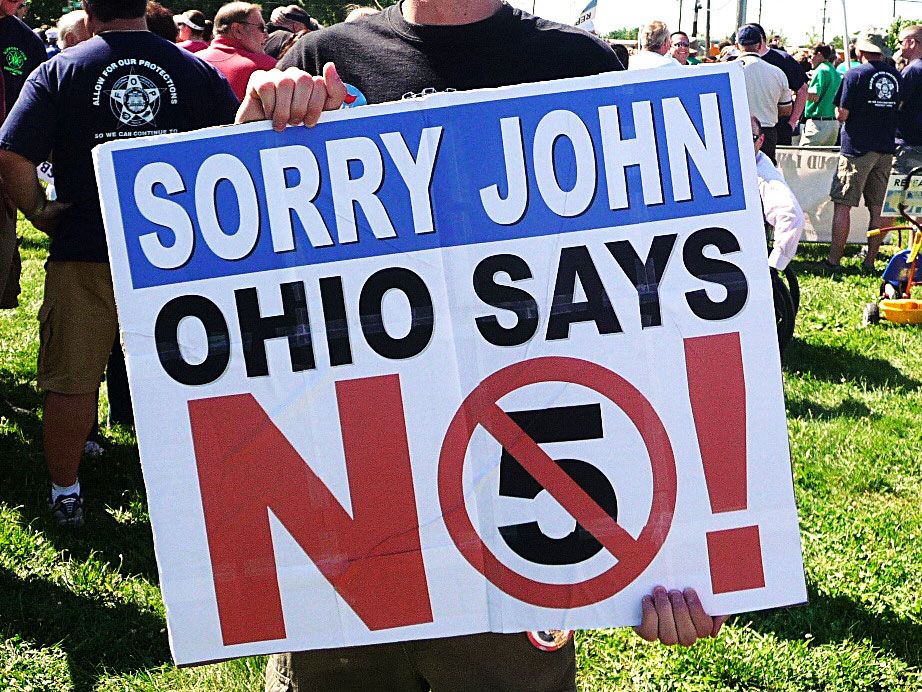
Kasich’s first major act as governor was working with State Senator Shannon Jones (R-Springboro) to introduce the infamous Senate Bill 5. SB 5 would have stripped public employees of any meaningful collective bargaining rights. Management would be able to impose contracts, and employees couldn’t strike. Despite the public outcry and opposition, the legislature passed the bill. In November 2011, the people of Ohio overwhelmingly voted to repeal SB 5 in a referendum vote.

Image result for ohio sb 5
Anti-SB 5 sign at 2011 rally in Columbus

It is worth emphasizing that, although all public employees would have had their labor rights much reduced, faculty would have been prohibited from having any unions whatsoever–this when faculty at 11 of the 14 public universities in the state are unionized. This singling out of faculty demonstrates a lack of appreciation for faculty work and/or represents an effort to silence our faculties’ public expressions of concern over the erosion of the emphasis on the core academic missions of their institutions.

The referendum on Senate bill 5 did not stop Kasich from finding other ways to hurt public employees. Working with Republicans in the General Assembly, in 2013, the governor strong-armed the public employee retirement systems to adopt new requirements that would force systems to cut benefits and raise age and service requirements.

For example, with the State Teachers Retirement System (STRS), to which most of our members belong, active educators had their contributions raised from 10% to 14%, their final average salary figured using the last five years instead of the last three years of their careers, the service requirement increased to 35 years, as well as changes to the benefit formula and cost of living adjustment (COLA).

Other Considerations

Governor Kasich has been a strong proponent of gimmickry over substantive improvements, especially in terms of access and affordability. For instance, College Credit Plus (CCP) has alleviated the immediate costs to students but has actually compounded the financial stress on colleges and universities caused primarily by the declines in state support–and has actually led to escalating tuition for the courses that CCP students eventually do need to take to complete degrees. There is a ready parallel to the cuts in state taxes that have led to dramatic increases in local taxes supporting local governments and school districts. This gimmickry demonstrates a sort of shortsightedness and a lack of understanding of how colleges and universities pay their bills and remain sustainable public institutions over the longer term.

Consider also the impact of the Boards that Governor Kasich largely filled. The recent largely self-created financial crisis at Wright State is a salient example of a vision, driven by cronyism and in some cases outright corruption (according to the Ohio Attorney General, Ohio Inspector General, Ohio Auditor, and a half dozen federal departments and agencies) that has emphasized “investments” in every imaginable alternative to “instruction.” So, as the state has been slashing support, Boards have “invested” in all sorts of non-academic “initiatives” and “enterprises” that have drained reserves. Faculty have been implicitly and explicitly blamed for not being more “efficient” or “productive” when all elements of their workloads, even at Ohio State, have increased. Scapegoating is easier than blaming one’s appointees and, implicitly, one’s own decision-making. The Ohio Conference’s annual reports on higher education have shown where money is being ‘invested.”

Where is the legislation addressing administrative bloat, escalating deficit spending on athletics, campus construction and off-campus property purchases that seem especially counter-intuitive when enrollments have plateaued or declined and when an increasing percentage of instruction has moved online, etc., etc.? Colleges and universities need administrations and Boards with a sense of long-term stewardship; instead, we increasingly have itinerant administrators and politically partisan and largely corporate Boards.

Franklin County Charter Tax
The Ohio Democratic Party dedicated a page on its website to exposing how much money ECOT and other charter schools took away from public schools over a six-year period in each county, all on John Kasich’s watch.

What has occurred at the K-12 level is even worse than anything that has occurred at the post-secondary level, but it is instructive of the level of damage that can be done in a relatively brief period. Tens of millions of tax dollars diverted from public schools already challenged by under-funding were wasted on Ohio’s online alternative school, the Electronic Classroom of Tomorrow, or ECOT. Equally scandalous has been continued funding of charter schools, three quarters of which are performing at the level of the lowest-performing public districts to which they were supposed to provide a dramatic alternative. They are largely corporate schools, and much of the revenue is being siphoned off into administrative salaries and shareholder profits, while the teachers are grossly underpaid. Some of it is an outright swindle, with subsidiaries of the corporations operating the charter systems in just about all of Ohio’s major cities leasing space to the schools at multiple times the going rates for commercial rents. One would think that the multi-layered scandal involving ECOT and tens of millions of dollars in squandered public monies would, alone, have been enough to shame lawmakers away from these “alternatives.”

The Ohio State University Can Do Better

Despite the fact that Kasich has built a national reputation for himself through his 2016 presidential campaign as a civil candidate (who isn’t civil compared to Donald Trump?), Kasich’s time in Ohio was marked by abrasive remarks, attacks on public employees, and a dismal K-12 and higher education record. Indeed, since Kasich has been an outspoken critic of President Trump, it seems very fair to point out that the sort of open normalization of obvious conflicts of interest has been one of his main criticisms of Trump, but it’s hard to explain his being hired by a Board that he has largely appointed as governor as anything but such a willingness to benefit, even selectively, from such a flouting of established standards.

Someone who has exhibited a lack of support for public higher education, hostility toward faculty, and fundamental misunderstandings about academia should not be made the leader of Ohio’s flagship institution. We urge Ohio State to have an open and robust search for their next president.

Written by · Categorized: Blog

  • « Previous Page
  • 1
  • 2
  • 3
  • 4
  • 5
  • Next Page »
AAUP Ohio Conference, 222 East Town Street, 2W, Columbus, OH 43215