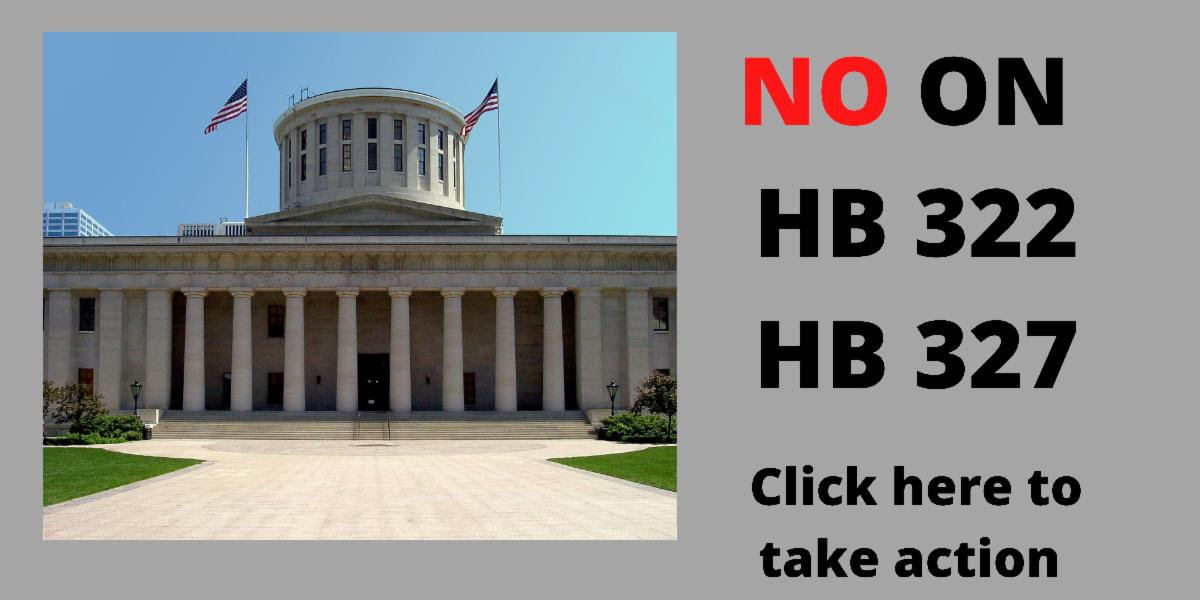
Take Action on Wednesday, September 22!: House Bill 322 and Substitute House Bill 327 (details below) are receiving another round of hearings on Wednesday, September 22 in the Ohio House State and Local Government Committee. It is important that committee members hear opposition to these bills.
E-mail: We have created an Action Network page through which you can e-mail your State Representative and the Representatives on the State and Local Government Committee to express opposition to the legislation. We recommend that you use your personal email address.
Call: Phone calls to the offices of the Republican majority members of the committee are particularly effective, as they are the ones who will determine whether this bill moves forward. Their names and numbers are below, along with a sample script.
Chair Scott Wiggam: 614-466-1474
Vice Chair Marilyn John: 614-466-5802
Rep. Jamie Callender: 614-644-6074
Rep. Rodney Creech: 614-466-2960
Rep. Bill Dean: 614-466-1470
Rep. Sarah Fowler Arthur (HB 327 Sponsor): 614-466-1405
Rep. Timothy Ginter: 614-466-8022
Rep. Diane Grendell (HB 327 Sponsor): 614-644-5088
Rep. Brian Stewart: 614-466-1464
Rep. Shane Wilkin: 614-466-3506
Sample Phone Script: Hello, I am calling to express my opposition to House Bills 322 and 327. As a professor at [your institution], I am concerned about how the legislation would infringe upon academic freedom. I don’t believe that state government should be dictating the content and manner of teaching on college and university campuses. I hope that the Representative will reject these bills and protect the integrity of higher education in Ohio.
Submitting Testimony: OCAAUP will be testifying as an opponent at an upcoming hearing. Our testimony will focus on how the legislation threatens academic freedom, employment and tenure decisions for faculty, accreditation, as well as State Share of Instruction funding. We also want to note that we spent much of the summer having conversations with the members of the State and Local Government Committee about our concerns.
Nevertheless, individual members may wish to testify in person or submit written testimony to convey how the bills will negatively impact them and their institutions. If you are interested in offering testimony, please email OCAAUP Executive Director Sara Kilpatrick at sara@ocaaup.org for more information.
About the Bills
As we reported to you in June, Ohio House Bills 322 and 327 would restrict the teaching of certain concepts and topics.
HB 322 primarily targets public schools and state agencies. While the Ohio Department of Higher Education would be included under the definition of state agency, it is unclear whether the bill would be applicable to state institutions of higher education.
This bill prohibits public entities from requiring discussion of current events and prohibits the teaching of a list of topics dealing with race, sex, slavery, and bias. It also targets history and civics courses, discouraging the discussion of current events, controversial issues, or activities that involve social or policy advocacy.
Moreover, the legislation specifies that teachers cannot be required to teach anything that goes against their “sincerely held religious or philosophical convictions.”
Substitute HB 327 is more punitive than HB 322 and also specifically targets institutions of higher education. The bill prohibits public schools, state agencies, colleges, and universities from offering teaching, instruction, or training on “divisive concepts” or accepting private funding to promote such concepts.
Violations of the bill would result in the withholding of funding to school districts or withholding of State Share of Instruction to colleges and universities. For one offense, 25% of SSI would be withheld. For a second offense, 50%, and for a third offense, 100% of SSI would be withheld.
The bill has a list of concepts related to race, sex, nationality, color, and ethnicity that it defines as divisive and therefore prohibits them from being “promoted.” It does say that divisive or controversial concepts can be taught if done so objectively and impartially, but who gets to determine what is objective and impartial is unclear.
Sub. HB 327 would require institutions to update policies on faculty tenure to reflect the bill’s principles and consider as a negative factor in employment and tenure decisions any confirmed reports that a faculty member knowingly or recklessly violates the bill’s provisions.
The legislation also would prohibit institutions of higher education from including “divisive concepts” in new student or freshmen orientation teaching, instruction, or training.
Here are several quick links so that you can read directly about the bills:
House Bill 322 Full Text
House Bill 322 Bill Analysis
Substitute House Bill 327 Full Text
House Bill 327 Substitute Bill Comparative Synopsis
September 2: Forum on HB 322/327
On Thursday, September 2 at 7:00 pm, the “Save Ohio Higher Ed” coalition will be hosting the Zoom forum: Honesty in Education: The Truth about Ohio’s “Divisive Concepts” Bills to discuss Ohio House Bills 322 and 327.
This is a great opportunity to learn more about these bills, which threaten academic freedom, accreditation, and institutional funding, and to learn what you can do to push back.
OCAAUP Weighs in on HB 248
Earlier this summer, the Ohio General Assembly made national headlines for introducing a bill that would ban virtually any vaccine mandates by a public or private entity, including institutions of higher education. The legislation — House Bill 248 — failed to advance at that time; but to the surprise of many, the House Health Committee returned early from summer recess on August 24 to resume hearings on the controversial bill.
At the hearing, Ohio Conference AAUP Secretary Lisa Voigt delivered opponent testimony to the committee. OCAAUP opposes this bill primarily because it would remove the ability for colleges and universities to make decisions in the best interests for the health and well-being of campus communities — decisions which faculty should be involved in making. At a time when faculty are expected to resume face-to-face instruction amidst a pandemic, now is certainly not the time to pull back even further on the public health measures that protect us.
You may recall that HB 244 — which banned institutions from requiring vaccinations that do not have full approval by the Food and Drug Administration (FDA) — was passed and signed into law in June. However, with the FDA granting full approval for the Pfizer vaccine yesterday, institutions are now in a position to mandate COVID-19 vaccinations, but not if HB 248 advances.
Here is a more complete overview of what is included in HB 248:
-Prohibit any of the following institutions from mandating, incentivizing, or “otherwise requesting” their employees, customers or students get vaccinated: A person (defined to include an individual, business trust, estate, trust, partnership, and association); public official or employee; public agency; state agency; political subdivision; school; child day-care center; nursing home; residential care facility; health care provider; insurer; institution (defined to include a nonprofit university, college, academy, or school); employer.
-Prohibit all entities from: (1) mandating, requiring, or otherwise requesting an individual to disclose the individual’s vaccine status or participate in a vaccine passport system, vaccine registry, or other mechanism designed for the purpose of tracking an individual’s vaccine status, (2) disclosing an individual’s vaccination status, and (3) making public an individual’s vaccine status.
-Repeal current Ohio law that requires a college student seeking to reside in on-campus housing to disclose to the college or university whether he or she has been vaccinated against hepatitis B and meningococcal meningitis.
-Public schools would have to provide information on vaccine exemptions in the same timing and manner, including text size and font, as it provides notice of the requirements.
-Prohibit certain state and local orders that would violate the provisions of HB 248.
-Authorize an individual to bring a civil action if the individual believes a violation has occurred and requires the court to award a prevailing plaintiff attorney’s fees, compensation for court costs, and any civil penalty the court considers appropriate.
-Prohibit a person, public official or employee, public agency, state agency, political subdivision from discriminating against a business that follows the provisions of HB 248.
After the hearing on August 24, it was reported that Republicans are putting the brakes on this legislation for now. We will keep you updated on this bill and other legislation as the General Assembly ramps up activity this fall.
Highlights of Final State Budget Bill
While Gov. DeWine has the ability to line item veto portions of House Bill 110, the state budget bill, before he signs it into law, here are the higher education highlights of the final bill as passed by the House and Senate:
-The Senate’s language to require the chancellor to approve any nursing programs at two-year colleges that meet certain criteria was included in the final bill.
-The conference committee also adopted the language from SB 135 about not allowing a state institution of higher education to withhold a transcript if an employer requires one, and the funding for the second chance grant pilot program remained in the bill.
-Additionally, the final bill would allow college athletes to profit from their name, image, and likeness (Gov. DeWine already had signed an executive order to this effect).
-The conference committee also included new language that establishes a task force to evaluate Wright State’s Lake Campus and create a long-term strategic plan.
-State Share of Instruction (SSI) will receive a 1.9% “increase” over the biennium, which fails to keep pace with inflation, let alone be the kind of real increase that our institutions desperately need to support students and academic programs.
-The Ohio College Opportunity Grant (OCOG), which supports low-income students, will receive an almost $11 million increase over the next two years, taking the fund to a total of over $219 million. While this is welcome news, it still falls well short of the $250 million that was envisioned when the grant was first established.
HB 322 & 327 Threaten Faculty, Higher Ed
Overview
There has been a rash of anti-academic freedom legislation cropping up in states across the country, and Ohio is no exception. The main purpose of these bills is to prohibit the teaching of “critical race theory” in primary and secondary education, but the bills tend to go much farther, and higher education has been a target, too.
Critical race theory (CRT) is an academic concept that has existed for more than 40 years. The core idea is that racism is a systemic social construct. Racism is not merely the product of individual bias or prejudice, but also is embedded in laws and policies.
Critics of CRT contend that it is divisive, teaches hatred for America, and indoctrinates students. Proponents believe that teaching about deep-rooted racial inequities is the only way to confront and remedy these systemic problems.
Last week, National AAUP President Irene Mulvey released a statement with allied organizations condemning efforts around the country that seek to restrict teaching about oppression, race, and gender. “Decisions about curriculum and teaching materials belong in the hands of educators–not politicians,” Mulvey stated.
Clearly, this type of legislation could impact whole disciplines in higher education and stifle the kinds of discussions that faculty have everyday with their students, which help students learn critical thinking and communications skills — and ultimately help to make them thoughtful, well-rounded citizens.
Ohio Legislation
Within the last few weeks, Ohio House Bills 322 and 327 have been introduced, which would restrict the teaching of certain concepts and topics.
HB 322 primarily targets public schools and state agencies, but the Ohio Department of Higher Education would be included under the definition of state agency.
This bill prohibits public entities from requiring discussion of current events and prohibits the teaching of a list of topics dealing with race, sex, slavery, and bias. It also targets history and civics courses, discouraging the discussion of current events, controversial issues, or activities that involve social or policy advocacy.
Moreover, the legislation specifies that teachers cannot be required to teach anything that goes against their “sincerely held religious or philosophical convictions.”
HB 327 is slightly different and more punitive than HB 322. It also specifically targets institutions of higher education. The bill prohibits public schools, state agencies, colleges, and universities from offering teaching, instruction, or training on “divisive concepts” or accepting private funding to promote such concepts. Violations of the bill would result in the withholding of funding to school districts or withholding of State Share of Instruction to colleges and universities.
The bill has a list of concepts related to race, sex, nationality, color, and ethnicity that it defines as divisive and therefore prohibited. It does say that divisive or controversial concepts can be taught if done so objectively and impartially, but who gets to determine what is objective and impartial is unclear.
HB 327 already had a substitute bill introduced last week. The substitute bill contains many changes that specifically target higher education.
For instance, the substitute bill would require institutions to update policies on faculty tenure to reflect the bill’s principles and consider as a negative factor in employment and tenure decisions any confirmed reports that a faculty member knowingly or recklessly violates the bill’s provisions.
The legislation also would prohibit institutions of higher education from including “divisive concepts” in new student or freshmen orientation teaching, instruction, or training.
Take Action!
Both HB 322 and HB 327 have had their first hearings for sponsor testimony. On Wednesday, June 23, the State and Local Government Committee will hold second hearings on the bills.
We have created an Action Network page through which you can e-mail your State Representative and the Representatives on the State and Local Government Committee to express opposition to the legislation. Please take action today!
____________________________________________________________________________
Here are several quick links so that you can read directly about the bills:
House Bill 322 Full Text
House Bill 322 Bill Analysis
House Bill 327 Full Text As Introduced
House Bill 327 Bill Analysis As Introduced
House Bill 327 Substitute Bill Comparative Synopsis
- « Previous Page
- 1
- …
- 21
- 22
- 23
- 24
- 25
- …
- 31
- Next Page »