AAUP Ohio Conference

American Association of University Professors

  • About
    • Who We Are
    • Board of Trustees
    • Staff
    • Committees
    • Events
      • Annual Meeting
      • Board Meetings
  • Membership
    • Chapters & Presidents
    • Join AAUP
  • Government Relations
    • Current Legislation
    • Find Your Legislators
    • SB 1 Toolkit
  • News & Blog
  • Donate

Jun 12 2020

Statement on Returning to Campus

The COVID-19 pandemic has created a tumultuous time in Ohio higher education. The emergency shutdown of our colleges and universities has drastically changed the nature of instruction, as well as the financial situations of our institutions.

This past semester, faculty across Ohio rose to the challenge of moving courses online, holding virtual office hours, adapting materials, and doing everything in our power to ensure that our students stayed on track. This was no small feat, but we are committed to our students’ success. 

Unfortunately, refunds to students, student withdrawals, reductions in state subsidy, and other issues culminated in severe budget problems for institutions, many of which were already dealing with financial troubles. This has resulted in numerous terminations of vital faculty and staff.

Despite strong online summer enrollments at a number of institutions, the fall semester remains a question mark. Undoubtedly, a major part of the college and university experience for students is physically being on campus — being among peers and engaging in face-to-face instruction. 

Many Ohio institutions already have announced broad plans for a physical return to campus. We are keenly aware that the financial impact of not being on campus at all may result in a further erosion of revenue that would be unsustainable for most institutions.

However, the leading medical experts in our state and nation have called into question the safety of being on campus again this year. The nature of living in residence calls, sharing enclosed spaces such as lecture halls, as well as student gatherings on and off campus facilitate a breeding ground for infectious diseases like COVID-19. 

We call upon each college and university administration to work closely with faculty, staff, and students on developing plans for fall semester. Among the issues that should be addressed if face-to-face instruction should resume in any fashion: 

  1. The preservation of academic freedom by granting faculty the final say in instructional delivery, with special considerations given to faculty with underlying medical conditions;
  2. Required mask-wearing and encouragement of frequent hand-washing/sanitizing;
  3. Initial and periodic testing of students and faculty for infection, especially since many who are infected remain asymptomatic; contact tracing and isolation for anyone who tests positive; 
  4. Reconfiguration of classrooms, residence halls, and dining halls to ensure proper physical distancing;
  5. Other measures that encourage the entire campus community to practice social distancing and good hygiene. 

No matter the precautions taken, there is great risk in moving forward with campus re-openings. The only way to successfully avoid compromising the health and safety of faculty, staff, and students is for everyone in our campus communities to buy-in to a new (hopefully temporary) culture that focuses on safety. The only way to have buy-in is for everyone to participate in these critical decisions.
Written by · Categorized: News

Jun 09 2020

Wittenberg AAUP sends open letter to university president

The following is an open letter sent by the members of the Wittenberg AAUP chapter to their university president. The Ohio Conference AAUP fully supports the chapter and their efforts to promote and enforce standards of shared governance.

June 9, 2020

An Open Letter to the President,  Provost, Board of Directors, and Faculty of Wittenberg University

We, the members of the Wittenberg Advocacy Chapter of the AAUP write to voice our deep concern about Wittenberg’s future given decisions about the University being made outside of and inconsistent with the long history of shared governance at Wittenberg University.  

We are cognizant of the need for significant changes in order to meet Wittenberg’s challenges and the rapidly changing higher education environment.  Many of these challenges were present prior to our 2019-2020 admissions decline and are of course exacerbated by our low enrollment numbers and the impact of the global health crisis on recruitment, retention and the general financial stability of the institution.  

However, the publicly announced plan by the Board of Directors to suspend portions of the Faculty Manual, when/if deemed necessary, and the lack of transparency about ongoing deliberations outside of normal faculty governance structures, in lieu of declaring financial exigency, creates multiple concerns.  We are worried in particular about the impact that AAUP sanction – for violation of shared governance – would have on the reputation of the University.  The stated intention of the administration to suspend parts of the Faculty Manual is a direct violation of the national AAUP’s Principles and Standards for the Covid Crisis.  As stated in this document:  “Under the academic principles and procedural standards long promulgated by the AAUP, such action is unacceptable.”

Moreover, we have grave concerns about the ways in which decisions are being made currently  and into the immediate future that will affect our curricular integrity, and how those decisions and processes might be received by our accreditation agency, the Higher Learning Commission.  While faculty, for instance, are members of the Academic Futures Committee, these four faculty (on a committee of eleven members) were hand-picked, not elected, and therefore not truly representative of “the faculty.”  Similarly, the administration recently appointed members to three faculty “summer working groups” whose accelerated timeline to generate curricular proposals also circumvents regular faculty governance processes.  

Our chapter receives regular guidance from the Ohio AAUP, and represents a variety of faculty from different levels of seniority and departments/disciplines.  Our goal is to partner with Wittenberg’s administration in the spirit of shared governance to make needed changes.  

We urge the Board of Directors and the Administration to restore responsibility for the curriculum to the Faculty.  We stand ready to work together to help Wittenberg into a great future. The time for an open, transparent and cooperative partnership is now.  The alternative – a secretive, misguided strategy plagued with mistakes – is not the way forward.  The process currently outlined by the Board of Directors violates the standards set by the national organization representing academic professionals. 

The Faculty Members of the Wittenberg University Advocacy Chapter of the AAUP

Written by · Categorized: News

May 19 2020

Urge federal lawmakers to provide relief for colleges, universities

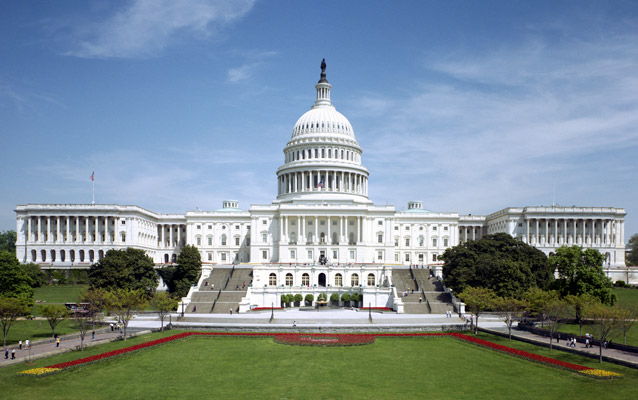
United States Capitol (U.S. National Park Service)

National AAUP has started an online letter campaign to federal lawmakers urging more aid to higher education. Please send messages to your U.S. Representative and Senators through this page.

While there is no silver bullet that will reverse the layoffs/terminations of faculty and staff at Ohio colleges and universities, as well as institutions around the country, more direct aid from the federal government can help stem the bleeding and perhaps save some jobs.

Written by · Categorized: News

May 11 2020

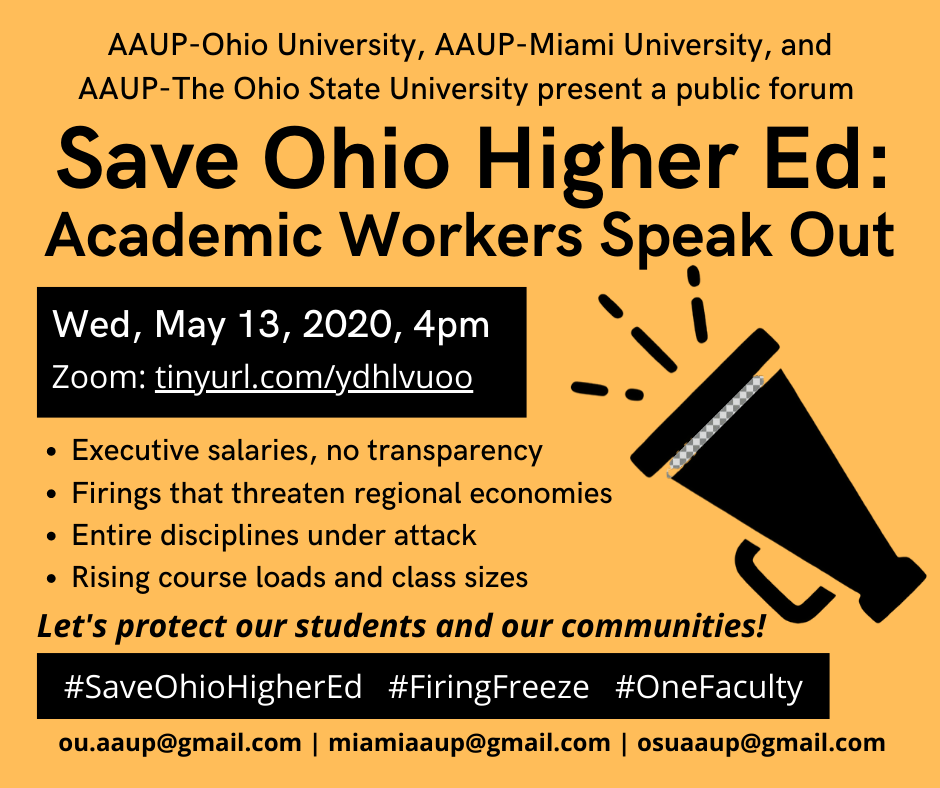
Miami, OSU, and OU AAUP Chapters to Host Public Zoom Forum on 5/13

Higher Education across the State of Ohio is under threat. Join your colleagues and co-workers from Miami University, Ohio State University, and Ohio University at 4:00 pm on Wednesday, May 13 to learn about the dramatic cuts already happening at Miami and OU, and to strategize about how we can all support one another in resisting deep cuts to academics and damage to our broader communities.

Please register for the Zoom meeting by clicking here and share this announcement widely. Contingent faculty, graduate students, campus workers, undergraduates — all are welcome.

Written by · Categorized: News

May 07 2020

DeWine announces higher ed cuts. Here is what you can do.

Gov. Mike DeWine announced a total of $775 million in spending cuts for the rest of the fiscal year ending on June 30, 2020 at his press briefing yesterday, May 5. The cuts will be implemented over the next two months to balance the state budget. The governor chose not to tap the state’s “Rainy Day Fund” at this time, saying that it likely will be needed in the next fiscal year and possibly the year after that.

With soaring unemployment and declining tax receipts, DeWine had notified state agencies near the end of March that he would be seeking budget reductions for the 4th quarter of the fiscal year. Departments were required to submit their reduction plans by April 7. We had written to Chancellor Gardner on March 30 urging that State Share of Instruction (SSI) remain as intact as possible, and also asking him to encourage institutions to refocus their spending on the academic mission.

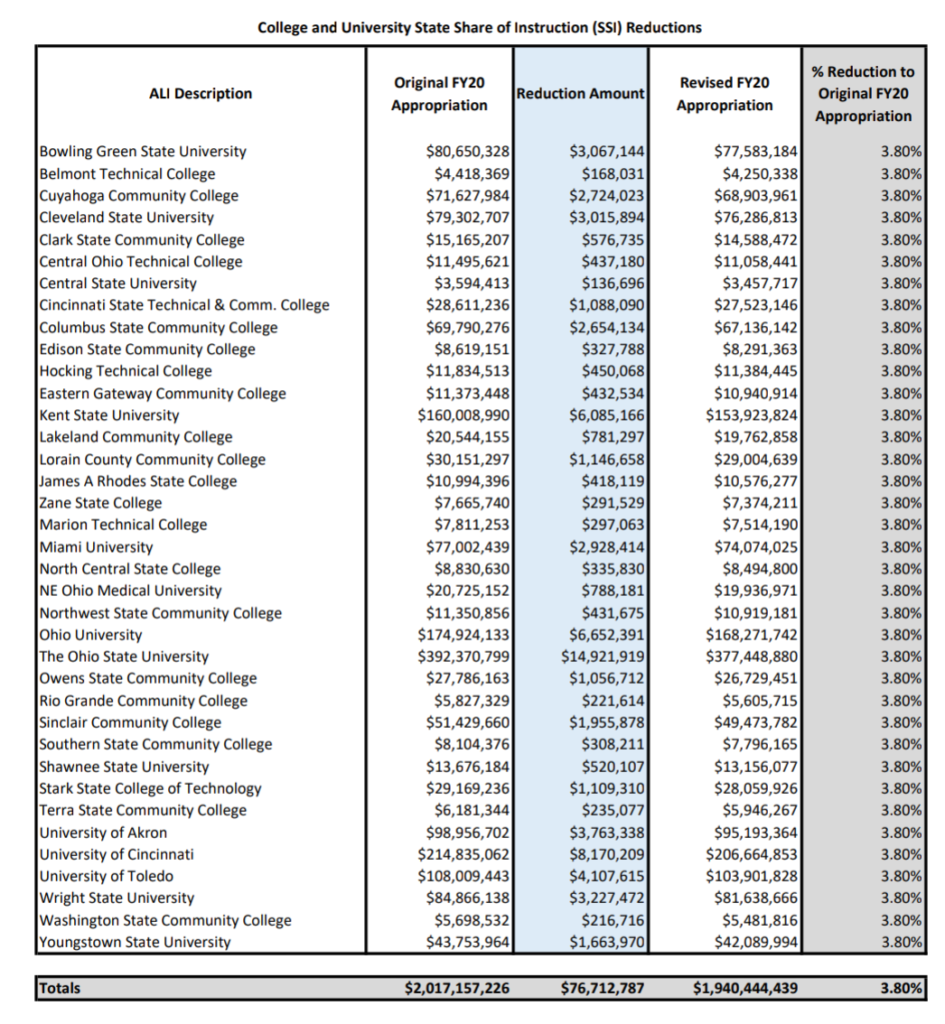
Nevertheless, among the $775 million in cuts is a $110 million loss to the Ohio Department of Higher Education (ODHE). Given that SSI — the main funding source from the state to public colleges and universities — makes up more than 70% of the ODHE budget, it was no surprise it bore the brunt of the cuts. A total of $76,712,787 in SSI cuts are being made in the less than two months remaining of this fiscal year.

In terms of percentages:

-The overall cut of $110 million to ODHE represents a 4% cut to original FY 20 appropriations, or a 16% cut for the 4th quarter.

-The cut to SSI represents a 3.8% cut from the original FY 20 appropriations, or a 15.2% cut for the 4th quarter.

Below is the chart that the state budget director released detailing the specific cuts to each public college and university.
This is obviously bad news for our institutions that already are under tremendous financial pressures. Many, if not most, institutions are projecting deficits in the tens of millions over the next year. However, we still do not know what cuts for FY 2021 might look like or when those will be announced.

While the federal stimulus money should mitigate some of the immediate state funding loss, institutions are still facing uncertainty about summer and fall enrollments and whether campuses will be open this fall, in addition to issuing refunds in the millions to students for housing, food, and other fees for spring semester. Several universities already have announced massive layoffs and restructuring plans, and it is only a matter of time before other institutions put out their reduction plans.

We recognize that our institutions are being faced with these serious and immediate fiscal challenges, and we encourage our chapters to engage and negotiate with their administrations to navigate these challenges as effectively as possible — to try to insure that instruction and our academic missions remain the first priority and not just a public talking point.

Chapters should, however, view with skepticism any demands from administrations for longer-term “solutions” — “master planning.” This situation is too fluid for anyone to do more than guess at where things will be in three to six months, never mind beyond that. Things may very well get worse, but what “worse” will be remains a very open question. In short, we think that remaining at the table and engaged is the best strategy, even if it becomes somewhat grueling.

We also need the federal government to step in with another relief bill that gives more direct aid to colleges and universities; otherwise, many of our institutions will be significantly limited moving forward. The changes that will be made in the immediate future will have long-term consequences.

The One Ohio Now coalition, to which OCAAUP has belonged for many years, is spearheading a letter campaign to Ohio’s federal lawmakers asking for another investment in Ohio’s educational institutions and other vital public services. We strongly urge you to send messages to your U.S. Representative and U.S. Senators through this link to advocate for more funding for institutions of higher education.

We also encourage you, if you have not done so already, to sign our statement that calls for solidarity among faculty at this time, and also calls upon institutions to refocus resources on the instructional and research missions. We plan to share this widely with administrators and state and federal lawmakers. As the statement indicates, we cannot accept further cuts to academics while administrative bloat and athletics largely remain unscathed. We can’t end up as institutions with ranks of vice presidents, fully-staffed athletic departments, and little to no faculty. After all, it is academics and the faculty that actually generate the revenue for our institutions.

Moreover, while there is not much that state legislators can do about appropriations to higher ed in the immediate future, we can help keep our issues in front of them by sending a letter supporting HB 603, which would require the chancellor to conduct a study on how to assist colleges, universities, and students during the pandemic.

We know that this is an extremely difficult time, and we appreciate those of you that participated in our day of action and solidarity on May 1 to help boost morale and highlight the importance of higher education before, during, and after this pandemic crisis. We will continue to do everything in our power to advocate for the value of higher education, higher education funding, and the importance of the role of the faculty.

Written by · Categorized: News

  • « Previous Page
  • 1
  • …
  • 22
  • 23
  • 24
  • 25
  • 26
  • …
  • 28
  • Next Page »
AAUP Ohio Conference, 222 East Town Street, 2W, Columbus, OH 43215