THE RUMORS

Recently, Columbus’ local NBC affiliate reported that Ohio State University trustees are considering making former Ohio Gov. John Kasich the next university president in the wake of current President Michael V. Drake’s announced retirement.
But rumors have swirled around for much longer that Kasich would want the job if his U.S. presidential aspirations fizzled. Some speculated that the trustees named Drake president to warm the seat for Kasich, knowing that Drake wouldn’t serve for long.
BACK-SCRATCHING
Just like with Miami University, which paid Kasich $40,000 for a speech last month, Kasich appointed most of the Ohio State trustees. More than half of the voting (non-student) trustees gave political contributions to Kasich prior to their appointments:
Gary R. Heminger, Chair: $2,700
Timothy P. Smucker, Vice Chair: $2,700
Cheryl L. Krueger: $2,000
Erin P. Hoeflinger: $2,700
Alan A. Stockmeister: $2,700
John W. Zeiger: $1,000
Elizabeth P. Kessler: $2,700
Jeff M.S. Kaplan: $2,700 (plus $3,900 during his congressional career)
First campaign contributions for Kasich. Then Board seats for his contributors. Next the OSU presidency for Kasich? This type of nepotistic circle is corrupt and inappropriate in the public sector.
Besides the appearance of impropriety, there are many reasons OSU trustees should not appoint John Kasich as the 16th president of their institution.
GOV. KASICH’S HIGHER ED RECORD
As governor, Kasich was no friend to public higher education. Let’s review.
Kasich’s 1st Budget – 2011
In his first biennial budget in 2011, Kasich slashed the main funding source to colleges and universities (State Share of Instruction or SSI) by 12%.
In that same budget, the governor attempted to undermine the whole concept of public universities by proposing a “charter university” system. The idea was that, in exchange for less state funding, universities would be “freed” from many state regulations (such as tuition caps, construction requirements, public records laws).
Fortunately, the legislature cut this proposal from the final budget. However, the compromise was to allow universities to lease “auxiliary services,” such as parking and residence halls, to private companies.
Ohio State has taken advantage of this by leasing its parking system in 2013 for a 50-year period in exchange for a one-time $483 million payment. Similarly, the university leased its energy facilities in 2017 for 50 years for an upfront payment of $1 billion.
While these seemingly lucrative deals are undoubtedly tempting for universities which have been left behind by the state, essentially selling off public assets for one-time payments is short-sighted and an unsustainable budgeting model.
Moreover, Kasich was openly hostile toward faculty in his inaugural budget. During his initial gubernatorial campaign, he said he would make professors work harder. This was ironic, given that Kasich had just come off of a very lucrative deal to appear in an OSU classroom for $4,000 an appearance. He was paid $50,000 a year for no more than four visits to the classroom per term. After milking the system for so much money for doing so little, it is hard to understand how he could possibly criticize full-time faculty.
Nevertheless, Kasich’s executive budget included a provision that faculty would have to teach one additional course every other year (with no end date or other specificity). Perhaps he thought that every professor earned $50,000 for giving four lectures a term.
Yes, while sending a message with charter universities that universities were too burdened with regulation, Kasich wanted to micromanage faculty workload. The legislature ultimately abandoned this idea, too.
Kasich’s 2nd Budget – 2013
In his second biennial budget, Kasich couldn’t help himself but to introduce yet another workload mandate for faculty. This time, he was sure to include greater specificity. All research and instructional faculty would have had to teach one additional course from the previous academic year. The language, however, was permissive — boards of trustees could choose to adopt this or not. Nevertheless, legislators decided to eliminate it from the final bill.
In addition, it was this budget that Kasich introduced a new funding model for higher education, one that moves away from enrollment to one based primarily on course completions and graduations. We warned the legislature of the perils of moving from an opportunity-based system (enrollment) to a production-based system (course completions and graduations). Legislators did not heed our warnings, and our predictions have come to fruition.
As a result of the new funding model, institutions that have selective admissions, and thus more students that perform well, are being even more rewarded with SSI dollars. Conversely, this has hurt open-access institutions, and has incentivized them to become more selective with admissions.
Moreover, Kasich pushed for a vast expansion of Post-Secondary Enrollment Options (PSEO) by introducing “College Credit Plus” (CCP). It used to be the case under PSEO that high-achieving high school students could earn college credit by attending classes at their local college or university. But under CCP, even 7th graders can take “college” courses, most of which are taught in the high school. Rather than properly fund higher education, Kasich’s idea with CCP was that students and the state can save money by pushing students through their education as quickly as possible.
But, as usual, he ignored the unintended consequences. The lower division classes that are now the core of CCP have been the bread and butter of colleges and universities, which have suffered financial harm by CCP usurping these courses.
Of course, the irony was probably lost on Kasich and Republican legislators that they want public high schools to teach college courses, even though they contend the same schools are inadequate as a justification for “school choice”/support for charter schools.
Kasich’s 3rd Budget – 2015
A big piece of the governor’s third budget was pushing “competency-based education” (CBE). The idea behind CBE is that one can take a test to prove that they know material rather than having to take courses they might not otherwise need. CBE has been used for many years in fields where it is easy to ascertain competency, and we have no problem with that.
However, Kasich welcomed with open arms Western Governors University – – a “university” without any faculty — to lead the charge of CBE in Ohio.
Kasich’s 4th and Final Budget – 2017
In his final budget, the governor successfully pushed through a provision to formally recognize Western Governors University as an Ohio institution. With Ohio public colleges and universities competing for students and resources, giving a formal stamp of approval to a “university” with a dubious record of student success (when compared to similar programs at other institutions) was baffling.
Kasich’s budget also would have required public institutions of higher education to pay for students’ textbooks, allowing the institutions to charge students only up to $300 to defray those costs. With what resources, governor? That unfunded mandate was cut from the bill.

The funding that Kasich proposed for SSI in his final budget was still slightly lower than the SSI funding in actual dollars in Gov. Strickland’s final budget. Of course, when accounting for inflation, the Kasich’s funding for higher ed looks even worse. Ohio’s percentage change in per pupil spending from 2008 to 2016 was -15.2%.
Throughout his tenure as governor, Kasich successfully pushed several income tax reductions that overwhelmingly favored the wealthiest Ohioans. All the while, public goods and services, including higher education, unnecessarily suffered.
KASICH’S RECORD ON PUBLIC EMPLOYEES
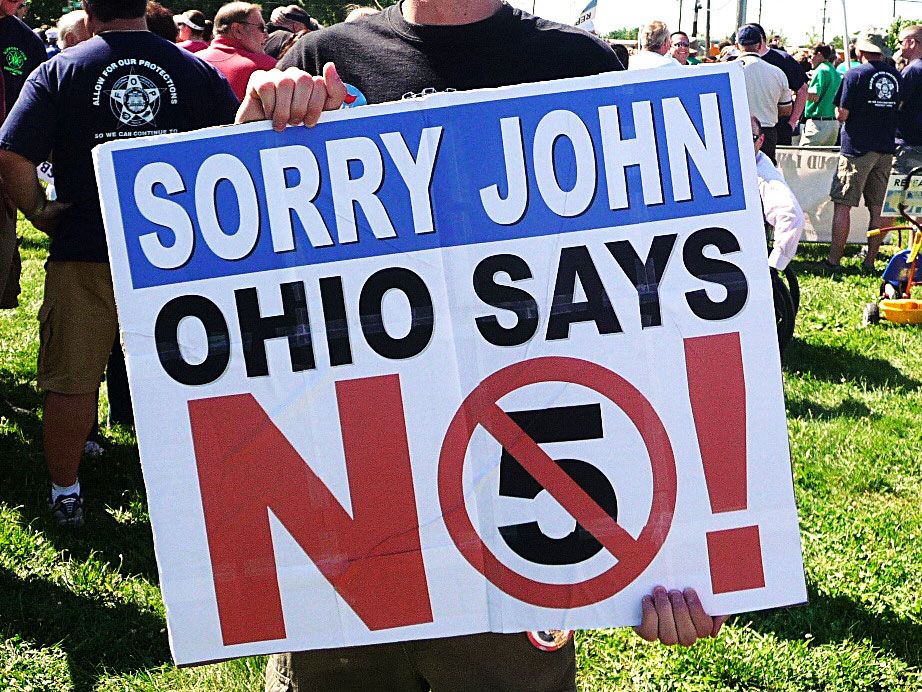
Kasich’s first major act as governor was working with State Senator Shannon Jones (R-Springboro) to introduce the infamous Senate Bill 5. SB 5 would have stripped public employees of any meaningful collective bargaining rights. Management would be able to impose contracts, and employees couldn’t strike. Despite the public outcry and opposition, the legislature passed the bill. In November 2011, the people of Ohio overwhelmingly voted to repeal SB 5 in a referendum vote.
But that didn’t stop Kasich from finding other ways to hurt public employees. Working with Republicans in the General Assembly, in 2013, the governor strong-armed the public employee retirement systems to adopt new requirements that would force systems to cut benefits and raise age and service requirements.
For example, with the State Teachers Retirement System (STRS), to which most of our members belong, active educators had their contributions raised from 10% to 14%, their final average salary figured using the last five years instead of the last three years of their careers, the service requirement increased to 35 years, as well as changes to the benefit formula and cost of living adjustment (COLA).
THE OHIO STATE UNIVERSITY CAN DO BETTER
Despite the fact that Kasich has built a national reputation for himself through his 2016 presidential campaign as a civil candidate (who isn’t civil compared to Donald Trump?), Kasich’s time in Ohio was marked by abrasive remarks, attacks on public employees, and a dismal K-12 and higher education record (we haven’t even touched his scandalous record regarding K-12 charter schools, which garnered national scrutiny).
Someone who has exhibited a lack of support for public higher education, hostility toward faculty, and fundamental misunderstandings about academia should not be made the leader of Ohio’s flagship institution. We urge Ohio State to have an open and robust search for their next president.


