AAUP Ohio Conference

American Association of University Professors

  • About
    • Who We Are
    • Board of Trustees
    • Staff
    • Committees
    • Events
      • Annual Meeting
      • Board Meetings
  • Membership
    • Chapters & Presidents
    • Join AAUP
  • Government Relations
    • Current Legislation
    • Find Your Legislators
    • SB 1 Toolkit
  • News & Blog
  • Donate

Apr 04 2018

Vote in STRS Elections; Our Election Results; PACs Formed

Two STRS Board Positions Up for Election

If you’ve not already, you soon should be receiving information in the mail about voting in this year’s State Teachers Retirement System (STRS) elections. Two Retirement Board positions are to be elected for four-year terms starting in September.

We are encouraging the election and re-election of Ben Pfeiffer and Dale Price, respectively.

The Ohio Conference has been a member of the Healthcare and Pension Advocates of STRS coalition (HPA) for many years. Our executive director Sara Kilpatrick and retired Wright State economics professor and AAUP president Rudy Fichtenbaum attend these meetings regularly. As members of HPA, we have worked with other employee organizations, as well as employer and retired educator groups, to communicate with STRS staff and Board members about secure retirements for those we represent.

While we have the utmost respect for the leadership of STRS and the fiduciary responsibility they have to the system, we have been disappointed by many of the decisions made over the last several years, which have relied too heavily on asking more of active educators and decreasing benefits for current and future retirees.

Mr. Pfeiffer and Mr. Price are both members of the Ohio Federation of Teachers (OFT). They understand the fiduciary responsibility that the Retirement Board has to the system, but believe those interests must be balanced with the real-world impact these decisions have on STRS members. The five key tenets of their platform are below.

  1. We want STRS to take a positive approach to restoring the COLA.
  2. We want more transparency on hedge funds fees.
  3. We want elected STRS board members to communicate regularly with actives and retirees.
  4. We want STRS to be responsible investors while protecting the defined benefit, addressing opioid crisis and other social and environmental causes.
  5. We want to ensure that STRS construction contractors are union-friendly, and we want STRS construction work done by unions as much as possible.

We hope that you will take the time to vote in these important elections to help diversify the voices on the STRS Retirement Board.


2018 OCAAUP Election Results

President, Secretary, At-Large Position elected
Thanks to our candidates and to all of our members who cast ballots. We are pleased to announce the results below.

President
John T. McNay (University of Cincinnati)

Secretary
Constance Kendall Theado (University of Cincinnati)

At-Large Member from a Private Institution
Chris Howell (Oberlin College)

Board terms for these trustees begin September 1, 2018 and end August 31, 2020.


Two PACs Formed by AAUP-WSU

The Wright State AAUP chapter has established two political action committees (PACs) to raise funding to support candidates in elections for state offices in Ohio.

The two PACs have the same straightforward mission: to support candidates who have records of supporting public higher education and collective bargaining rights.

Both PACs will rely on voluntary contributions.

The AAUP-WSU PAC has been established for members of the AAUP-WSU bargaining unit.

The SmartALEC(k) PAC has been established for anyone else who wishes to support candidates who support public higher education and collective bargaining rights. In other words, any other AAUP member in Ohio could make a contribution to this PAC.

Because AAUP-WSU needs to submit records on contributions made to both PACs, no anonymous contributions are permissible.
Contributions should be mailed to:

PAC Name: AAUP-WSU PAC or SmartALEC(k) PACAAUP-WSU113 Medical Sciences BuildingWright State UniversityDayton, OH 45435

Questions can be directed to AAUP-WSU President Marty Kich at martinkich@gmail.com.

Written by admin · Categorized: Uncategorized

Mar 07 2018

Latest from the Statehouse & Candidate Statements

State Legislative Update

The Ohio General Assembly has been back in full swing since after the holidays. Below are updates on specific bills that we have been tracking.
Sub. HB 66 – “Tenured Faculty”As we have reportedly previously, Substitute House Bill 66 began as a bill that would have required all tenured university faculty to teach at least one three-hour undergraduate course each semester.

A substitute bill instead was introduced to create a study committee responsible for assessing universities’ commitments to their undergraduate mission, including how they encourage tenured faculty to contribute to the undergraduate mission.

The bill passed the Ohio House of Representatives in December and has begun receiving hearings in the Ohio Senate. OCAAUP will offer interested party testimony when the opportunity presents itself in the near future. As we did in the House, we plan to point out that undergraduates may not be getting enough face-time with tenured and other full-time faculty not because those faculty don’t have a commitment to teaching, but because institutions have chosen to hire armies of adjuncts, in part, due to insufficient state funding.

HB 512 – “Mega-Bureaucracy of Education”You may have read about House Bill 512 in the newspapers over the last couple of weeks. This legislation is receiving much attention, as it is proposing an extensive structural change to Ohio’s educational system. The bill would create what some are calling a “mega-department” or “mega-bureaucracy” of education. The Department of Education, Department of Higher Education, and Office of Workforce Transformation would be merged and headed by one appointee that would be part of the governor’s cabinet.

While we support Ohio’s educational agencies working closely together, HB 512 would give tremendous educational policy power to one political appointee. By involving the Office of Workforce Transformation, a concern is that too much emphasis will be placed on responding to economic changes rather than delivering a high-quality and well-rounded education to students.

This bill is fully supported by Republican House leadership and Gov. Kasich, and is expected to pass the House by summer. On the other hand, key members of the Ohio Senate have expressed concerns and are not as eager to pass such a sweeping proposal under a lame-duck governor.

The Ohio Faculty Council testified against the bill at its third hearing earlier today. You can view the testimony here.

Sub. SB 216 – “Public School Deregulation Act”Senate Bill 216 primarily deals with K-12 teaching and testing requirements. As originally drafted, though, it also would have made a dramatic change to the College Credit Plus (CCP) program, requiring that all CCP courses be taught at the high school unless the high school course is fully enrolled or not offered.

However, after push-back from higher education stakeholder groups, including us, the Ohio Senate Education Committee introduced a substitute bill eliminating the CCP provision.


2018 OCAAUP Elections: Candidate Statements

President, Secretary, At-Large Position to be elected
Please see the candidate statements for our 2018 nominees below. While all candidates have provided a short statement, only the position of secretary is contested.

President
John T. McNay (University of Cincinnati)
Statement: “In seeking another term as president of the Ohio Conference, I am hoping to continue to build on the progress that has been made over the last several years in important ways. One is enhancing the Conference’s role as an outspoken advocate of affordable and accessible quality higher education. Second is continuing to build the Conference’s role as a place where shared problems and concerns can be discussed and solutions developed in ways that help both our large and small chapters. Finally, I think the experience I’ve gained over the last few years will be an asset as we navigate the new world in the anticipated post-Janus decision. I would appreciate your support and am excited to serve another term.”

Secretary
John Blackburn (Ohio State University)
Statement: “I am the current secretary for the State Conference. I have been an AAUP member since 1985. I am currently the president of the Ohio State University chapter. The OSU chapter is trying to rebuild its membership, which is below the 100 members needed to have an automatic place on the Conference board of trustees. I would like to continue as secretary, because it provides the OSU chapter a board seat, where I learn much that is helpful for rebuilding the OSU chapter, while at the same time being of service to the Conference.”

Constance Kendall Theado (University of Cincinnati)
Statement: “Thank you for this opportunity to introduce myself as a nominee for the position of Secretary. I am an Associate Professor in the School of Education at the University of Cincinnati, where I also serve as the Director of Graduate Studies. I have been a member of the AAUP since arriving at UC in 2007, have served as an At-Large member of the UC-AAUP Executive Council for four years (2012-2016), and am just completing a two-year term as Vice President (2016-2018). I am committed to the fundamental values of academic freedom and shared governance the AAUP advances, and believe that the experience gained as an active Executive Council member for my
local Chapter has prepared me to contribute productively to the OCAAUP agenda of advocacy for Ohio’s college and university professors. I ask for your vote and look forward to representing your interests in the critical statewide conversations and legislative decisions impacting higher education, generally, to protect the welfare of our union membership, in particular, now and in the future.”

At-Large Member from a Private Institution
Chris Howell (Oberlin College)
Statement: “I have taught at Oberlin College for 28 years, where I am now the James Monroe Professor of Politics. I am running for the Ohio AAUP Board of Trustees to bring a private college perspective to the board, and to contribute in ways that benefit all faculty in Ohio. As a scholar of employment relations, chair of my institution’s Compensation Committee for the last five years, chair of our Governance Committee, and a member of every major elected committee at my college, I believe passionately in shared governance and academic freedom, and the need to protect them in the current era of corporate attacks. I am particularly interested in exploring the potential of union-like, alt-labor organizations for faculty at private institutions.”

On March 15, ballots will be e-mailed to all members. The election will run through the end of March and results announced by April 15.


Thanks for Rallying with Us!

On February 24, thousands of workers from across Ohio, including AAUP members, came together at the Statehouse for the Working People’s Day of Action to rally for workers’ rights. We stood in the cold and rain, but the weather didn’t stop us from speaking out against the Janus v. AFSCME U.S. Supreme Court case as well as state measures that seek to weaken the power of unions and workers as a whole. Thank you to those that showed up!

Written by admin · Categorized: Uncategorized

Feb 01 2018

Join Us in Columbus on February 24

Mark your calendars to participate in the Working People’s Day of Action on Saturday, February 24 at the Ohio Statehouse in downtown Columbus. We will begin assembling at 10:30 am with the program beginning at 12 pm. This rally is part of a National Day of Action being held in 10 cities across the U.S. to protect workers’ freedoms and support strong unions.

Why are we rallying?

Just as with the dangerous Senate Bill 5 from 2011, extreme politicians at the Statehouse are trying to take away collective bargaining rights and want to make Ohio a “Right-to-Work” state. But, instead of legislation this time, they want to put the attacks before Ohio voters with six proposed anti-worker ballots initiatives. Nationally, a U.S. Supreme Court case, Janus vs. AFSCME Council 31, would make the entire country “Right-to-Work” for public employees if the Court sides with anti-union groups such as the Koch Brothers, ALEC, and the National Right to Work Committee. The Court will hear oral arguments on the case on February 26 two days after the Working People’s Day of Action.

For these reasons and more, we need a strong showing of workers – public and private, union and non-union – against these attacks at the event on February 24! These attacks on public employees are no more than attempts to divide workers and limit our power. Because, as we all know, unions give workers a powerful voice to speak up for fair wages, affordable health care, a dignified pension, and strong public services.

And that’s why America needs unions now more than ever! Just as we did when we took down Senate Bill 5, when we join forces and stick together, we are unstoppable!

Look for the AAUP!

Look for your fellow AAUP members. We will have a large red banner and will be passing out Ohio AAUP t-shirts as long as they last. We hope to see you there!

Written by admin · Categorized: Uncategorized

Dec 25 2017

HB 298: another attack on sick leave and collective bargaining

Take Action on House Bill 298

Another attack on sick leave and collective bargaining

House bill 298, introduced by Rep. Derek Merrin (R-Monclova Twp.) would reduce sick days for those state employees who currently have 15 days down to 10 days. This includes college and university employees. The bill also would prohibit employers from offering greater than 10 sick days, or agreeing to more in a collective bargaining agreement. So not only is this an attack on benefits, it is an attack on collective bargaining rights.

Sounds familiar, doesn’t it?

That’s because nearly identical language was not only part of Senate Bill 5 in 2011, but also was inserted into HB 49 (the state budget bill) by Rep. Merrin earlier this year. Fortunately, we were able to get that language removed, but Rep. Merrin is intent on reducing what he calls “an excessive number of sick days.”

There are two things you can do right now to help stop this bill:

  1. Call your representative to tell them you oppose HB 298 and any legislation that curtails benefits and collective bargaining rights. Dial (844) 213-8172 to be connected to your state rep’s office. You will be asked to enter your zip code to be forwarded to the appropriate office.
  2. Send an e-mail to your representative through this link.

As we explained to legislators during the budget process, professors do not receive the same benefit leave time as other state employees, like personal and vacation days. As such, sick days are the only leave time that faculty can rely on in the event of a serious illness. During the budget, we heard from members who expressed how important that leave time was for them when they confronted serious illness.

While the extreme legislators behind this bill will tell you that it is about limiting sick days for public employees, we know the truth. This is just the first step in trying to silence our voice at the workplace. Today they try to limit how we collectively bargain for sick days; tomorrow it will be about limiting how we collectively bargain over pay, workload, as well as how we grieve unfair conditions. This is their attempt to pass Senate Bill 5 in piecemeal fashion, and we must fight back against ANY attempts to limit our voice on the job.

Please take a few minutes to call and e-mail your representative. Your activism does make a difference.

Deadlines Approaching for Annual Meeting

Join us in Columbus November 3-4

The 67th Ohio Conference AAUP Annual Meeting will be held at the Renaissance Columbus Downtown Hotel on November 3-4, 2017.

The deadline to reserve a hotel room in our block for that Friday night at the significantly discounted rate of $125 is Tuesday, October 3.

The final registration deadline, however, isn’t until October 27.

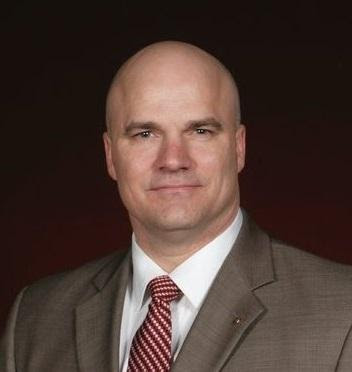
David Ridpath (pictured), NCAA expert and professor of sports administration at Ohio University, will deliver the keynote luncheon address on Saturday: “Shaping Policy and Practice in Intercollegiate Athletics: A Study of Student Fee Resource Allocation for Athletics and its Effect on Access and Affordability of Higher Education.”

In addition, Samantha Parsons from “UnKoch My Campus” will give a workshop that Saturday afternoon: “Pushing Back on the Power of Private Donors: Strategies for Building Your Chapter & Protecting the Academy.”

Moreover, members who are able to attend the Friday reception and dinner will have the opportunity to meet State Representative Kathleen Clyde (D-Kent), who is running for Ohio Secretary of State.

The preliminary agenda is available here.

We hope you’ll join us in Columbus for an informative event. It is a great opportunity to network with faculty from around the state. Registration costs just $25. Click here to register.

Education First Report Highlight: Building Debt

Ohio universities in massive debt due to construction

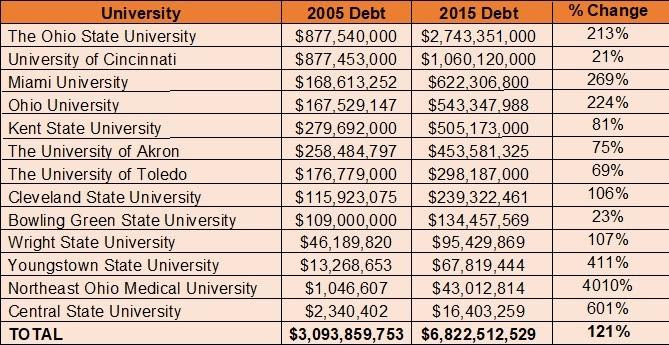
The next piece we will highlight from our latest Ohio Higher Education Report: Education First is university debt.

As you can see in the chart above, each Ohio university is carrying substantial debt, primarily on account of new building construction. Far beyond modernizing classrooms with today’s technology and building out of necessity, institutions have been on a spending spree, more than doubling total debt over 10 years. 

Institutions finance building projects in several ways: capital funding from the state, donations, and borrowing. As of early 2016, Ohio’s universities found themselves inching toward $7 billion worth of debt. 

Students end up footing the bill for these costly ventures. For example, according to a Columbus Dispatch editorial, “Even a small fee tacked onto student loans can snowball. The $110 per-semester student fee Miami University charges to finance its $53 million Armstrong Student Center…looks manageable enough. But added to a student loan, at 4.5 percent interest over 10 years, this increases the amount to be repaid by $1,100.” 

Institutions are taking a gamble in financing construction on the backs of students. They are building in the name of attracting students, yet risk alienating them with high fees. Colleges and universities must be more restrained when it comes to additional projects, and we have recommended that the state should consider capping the amount that institutions can borrow, as other states have done.

Read more about this issue in our report.

Written by admin · Categorized: Uncategorized

Dec 21 2017

Tenure, Sick Leave, CCP, & Anti-Labor Legislative Updates

Year-End Legislative Updates

Tenure, sick leave, CCP, and anti-labor proposals mark end of 2017

Sub. HB 66

The original version of House Bill 66 would have required a minimum undergraduate teaching load of three credit hours per semester for all public university tenured faculty. Upon facing push-back from stakeholders, the bill’s sponsor, Rep. Ron Young (R-Leroy Twp.), introduced a substitute bill that instead would create the “Undergraduate Mission Study Committee” to evaluate how each state university contributes to its undergraduate mission, including by encouraging face-to-face interactions between students and tenured faculty members.

The Higher Education and Workforce Development Committee adopted several additional amendments to the bill, including ones that add a member of the Ohio Faculty Council and member of the Ohio Student Government Association to the study committee, as well as one that would require the committee to study the breakdown of faculty at universities (e.g. full-time tenure track, full-time non-tenure track, and part-time faculty). The latter was our recommendation that was picked up and sponsored by Rep. Kent Smith (D-Euclid).

The bill was passed by the committee and passed the full House of Representatives on December 13. It has now moved on to the Senate, but has yet to be referred to committee. We expect that this legislation ultimately will be approved by the Senate and governor.

HB 298

During the state budget process earlier this year, an amendment was added by the House — but later removed by the Senate — to reduce sick leave for public college and university employees from 15 to 10 days. The same State Representative, Rep. Derek Merrin (R-Monclova Twp.), who sponsored that amendment has sponsored House Bill 298, which would reduce maximum sick leave accrual from 15 days to 10 days for all state employees who currently can accrue up to 15 days of sick time.

The bill had its first hearing, sponsor testimony, on December 12. Rep. Merrin presented this bill as a cost-savings measure for local governments and institutions of higher education, while calling 15 days of sick leave “excessive.” The representative failed to provide specifics about cost-savings and faced skepticism from the State and Local Government Committee members. We will continue to monitor this legislation. At this time, we do not have reason to believe that this is priority legislation for the majority caucus.

SB 216

This legislation had not been on our radar, as it ostensibly only dealt with K-12 deregulation and testing provisions. However, buried in the bill is a significant change to the College Credit Plus (CCP) program.

If the bill were to pass as currently written, students would be forced to take CCP courses at the high school. The only exceptions for a student to take a course at a college or university is if the high school course is full or not offered. The bill also calls for the Ohio Department of Education to study CCP. One would think that the program should be studied before a drastic change is made to its delivery. While we support and encourage the state to study CCP, we intend to voice our concerns and opposition to the mandate that these courses be taken at the high school with limited exceptions.

As we stated in our 2017 Ohio Higher Education Report: Education First, no one can guarantee that students are learning material at a collegiate level if being taught by high school teachers. The fact that CCP students are getting higher scores when taught by high school teachers is potentially evidence that students are not encountering the same rigor that they would at an institution of higher education. This isn’t to disparage high school educators — higher ed faculty shouldn’t be teaching high school any more than high school faculty should be teaching college.

Six Anti-Labor Proposed Constitutional Amendments

Rep. John Becker (R-Union Twp.), a recurrent sponsor of “right-to-work” legislation, has begun circulating a co-sponsor request for six proposed constitutional amendments. The legislature has the ability to initiate constitutional amendments to be placed on the ballot for voters to decide. Here are the six proposals as stated by Becker in his co-sponsor request:

  1. Private-sector Right-to-Work – No worker should be required to subsidize a union as a condition of employment. Additionally, this will tell the world that Ohio is “open for business.”
  2. Public-sector Right-to-Work – This is about freedom of association. Like for the private sector, no worker should be required to subsidize a union as a condition of employment.
  3. Public-sector Prevailing Wage – Repeals the requirement for taxpayers to pay artificially inflated wages, rather than those that are market-based. 
  4. Public-sector Paycheck Protection – This prohibits state and local government employers from withholding union dues or fees from workers’ wages. Additionally, unions will be prohibited from spending workers’ money on political activities without workers’ consent. 
  5. Public-sector Project Labor Agreements – This is the Michigan model approved by the US Court of Appeals for the Sixth Circuit. State and local government entities will be prohibited from engaging in contracts that minimize competition for construction projects by requiring that only union or non-union labor can be considered. A level playing field will be required. 
  6. Public-sector Union Recertification – Requires annual reconsideration and recertification of workers’ bargaining units. This will open up competition for new bargaining units, will give workers a chance to have their voices heard, and will make union leadership accountable to their membership.

Given that we are entering a big state election year, we would be hard-pressed to believe that Republican leadership would have the appetite to pursue such anti-labor initiatives, especially ones that could drive traditionally Democratic voters to the polls. Nevertheless, the We Are Ohio labor coalition is taking this seriously and pushing back against this onslaught of bad ideas that will hurt working Ohioans.

Please take a moment to send a letter to your State Representative, urging them to reject these anti-worker initiatives.

Reminder: Nominations Open for 2018 Conference Elections

President, Secretary, At-Large Position to be elected

We are seeking nominations for the 2018 Ohio Conference AAUP Board of Trustees’ elections. In accordance with our governing document, you must have been a member for at least two years and current on your dues to be eligible for a trustee position. Members may self-nominate.

Nominations should be sent to Sara Kilpatrick, Executive Director, at sara@ocaaup.org no later than January 30, 2018. 

Below is the list of positions to be elected directly through the Conference elections this year. Those who are elected will serve a two-year term beginning September 1, 2018.

  • President
  • Secretary
  • At-Large Member: Private Institution (nominee must be a member of a private institution)

The President shall preside at Conference meetings and, with the approval of the Trustees, arrange for the Conference meetings and appoint Chairs of the standing committees; shall execute such matters as are referred to him or her at Conference meetings and by the Trustees; and, in consultation with the Trustees, shall take such other actions as are judged necessary to carry out the objectives of the Ohio Conference, and shall report at the next Conference meeting any actions taken by the Trustees during the time between meetings. The President shall serve as delegate to the Annual National AAUP meeting and to the Annual meeting of the Assembly of State Conferences.

The Secretary shall keep the Ohio Conference records, including minutes of meetings of the Trustees and of the Conference. The Secretary shall serve as a delegate to the Annual meeting of the Assembly of State Conferences.

The Conference has four Saturday Board meetings in Columbus each academic year that trustees are expected to attend, one of which is the Annual Meeting. They also oversee the executive director and provide direction for the organization.

Serving on the Board of Trustees is a rewarding way to engage in statewide AAUP issues and state government advocacy. If you have any questions, contact Sara Kilpatrick at sara@ocaaup.org. 

Happy Holidays!

We would like to take this opportunity to wish all of our members very happy holidays. It is because of your membership, support, and activism that the Ohio Conference is able to be an effective voice for faculty statewide. Thank you for helping to make 2017 a productive year, and we look forward to working together in 2018. Enjoy your break!

Written by admin · Categorized: Uncategorized

  • « Previous Page
  • 1
  • 2
  • 3
  • 4
  • 5
  • …
  • 16
  • Next Page »
AAUP Ohio Conference, 222 East Town Street, 2W, Columbus, OH 43215